Arts like Jiujitsu, Muay Thai, Wrestling, Boxing and few others are controlling the field of fighting, and their strong presence and influence are not necessarily due to some imaginary or irrational notion of TV entertainment. Also, it is not all due to the vested interests of the big media outlets putting the spot light specifically on them, though it certainly plays a big role; but, to some greater or lesser degree they can objectively be attributed to more subtle, more foundational, and maybe less obvious causes. Some of them can be directly or indirectly linked with the following elements:
1) Their supporters and propagators (leaders, instructors, fans) are less traditional-bounded, though they do have tremendous sense of respect and reverence for the roots of their arts and history, yet they don’t necessarily allow blind and fanatical loyalty to traditions sway or dictate the course of their objective progress. Their natural intuition in finding new solutions to new challenges enables them to identify new insights that can organize the new influx of information on new adaptive methods.
2) Such arts do not seek quixotism. On the contrary they are compatible with useful and practical philosophies——complimenting real biological and existential systems.
3) They are meticulously organized.
4) They are systematized and yet to greater and lesser degree they are also adaptive to individual needs and traits.
5) They spar, resist, and test their learnings and philosophical convictions in order to stay with an ever-evolving perception of reality; thus intercepting harmful attachments to impractical things that just sound good and fluffy in terms of philosophy, but have no real basis in the order of natural processes which would at least correlate with athletic endeavors, and robust studies on human biomechanics.
6) They are attribute and skill-oriented, rather than leaning heavily on technique-memorizations or event scenario practices——(as necessary as they may be).
7) They do not have a cultic behavior. By cultic behavior we mean a martial arts movement that demands and encourages blind following; is fanatically irrational; and strongly ideological in its attachments to all sorts of absurdities. Unfortunately, martial arts have been a big breeding ground for such movements in the past centuries, and many of them, including some new ones have come into existence again. This should be distinguished from those traditional arts that may still play a positive role in the development of arts and humanities.
8) Some of them are fan and family-oriented. It seems like they carry more interest in the fans due to their realism in real open public arenas; and more importantly, they are more or less family-friendly, and have been a big force in uniting and creating healthy community pockets of very diverse backgrounds. The life-skills gained through such arts have had a solid and consistently irrefutable record.
9) They can offer some practical and well-tested solutions to the whole picture self defense, even if it may be partial, and geared towards a particular range.
10) From an international perspective, they have played a big role in the strength, history, pride, and identity of many nations.
11) Under real pressures they are able to remain organized, systematized, and their internal mechanism have provided checks and balances through practical means to test not only oneself, but also the very art itself.
12) They do not accept anything at their face value, unless they are pressure-tested and proved to be practical and dependable. In other words, they don’t just do something because they had heard a legend used to do it. The internal mechanism of the art and its philosophy and techniques have to prove true for each fighting athlete, otherwise, the techniques or training methods would not earn their respect, and therefore they get discarded without much thought.
These twelve categories above do not, by any means exhaust the list. We hope the readers can draw some benefits from them through study, action and reflection.
Coach Shahram Moosavi
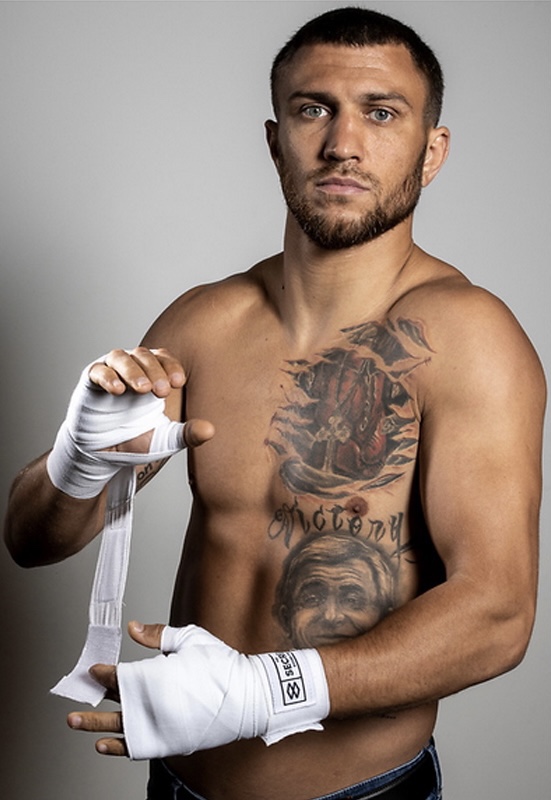
Vasyl Anatoliyovych Lomachenko