
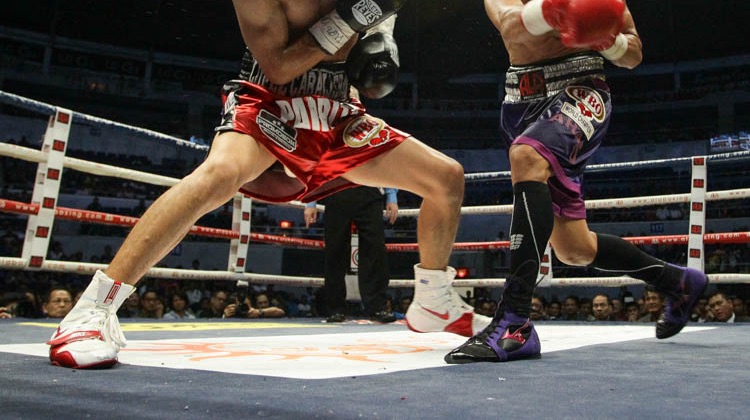
Empirical evidence highlights footwork’s pivotal role in combat sports, optimizing balance, agility, and striking precision. Footwork enables fighters to manage distance, evade strikes, and craft offensive angles. Sports science research, including biomechanical studies, shows that adept footwork reduces energy use by up to 25% and boosts reaction speed—vital for enduring rigorous rounds of fighting. Fighters with a dynamic footwork, have demonstrated to be able to pivot or shuffle 20-30% faster than those rooted flatly, per kinematic analyses.
Developing combat sports footwork starts with a solid stance: feet shoulder-width, knees bent, lead foot forward, but eventually they must acquire the instinct to follow efficiency and dynamic balance rather than a fixed stance/posture. Dominick Cruz’s 2016 bout with TJ Dillashaw showcases the importance of footwork—his lateral shuffles and pivots yielded a 47% strike success rate while evading 72% of counters (UFC data). Drills like ladder shuffles, cone pivots, or shadowboxing with directional shifts ingrain muscle memory, improving proprioception—body position awareness—linked to a 15% rise in strike accuracy in studies, however, weapons training enhances effective footwork at even higher rates of proficiency. 
Basic footwork should involve circling opponents, cutting angles (zoning), retreating when necessary, and so on. Conor McGregor’s knockout of Eddie Alvarez in 2016 exemplifies angle-cutting, creating openings for his left hand. Consistent repetition refines these mechanics, enhancing endurance and adaptability. Empirical data and fight footage confirm footwork as a quantifiable edge in combat sports’ chaotic environment.